
Arts VSP is ideal for students interested in gaining international experience, meeting students from other universities and experiencing Canadian culture, while enhancing their learning experiences in one of the world’s top ranked universities. Students will enjoy university residence life and will have the opportunity to take part in events and field trips organized specifically for Arts VSP students.
What you might expect/course format
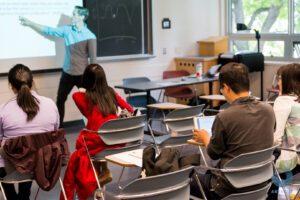
A typical course includes an interactive lecture and discussion component and will have a mix of in-class and take-home assignments. Assignments can also include individual or group projects, quizzes, and exams.
Some courses will offer academic field trips that take place on or off campus. These field trips complement classroom learning, and may include community engagement or fieldwork.
The Arts Vancouver Summer Program’s instructors and teaching assistants are committed to providing a supportive learning environment for students. During the program, instructors provide support in class and by email.
June 2027 Course Packages
From Drama to Theatre: How does a play mean? (Theatre)
This course will explore the languages of theatre within Vancouver’s rich and lively performance culture. How do individual artists–directors, actors, designers–transform a playwright’s ideas into unique and original art? In what ways, for example, will a Shakespeare play produced in Vancouver become a Canadian play? These questions and more will be explored in relation to two plays a week in production in Vancouver during the term. We will examine and discuss the play scripts, attend the plays, and meet “backstage” with some of the artists themselves. Plays chosen will span a variety of genres, including Shakespeare (in production at Bard on the Beach Shakespeare Festival), musicals (in production at Theatre Under the Stars and the Arts Club Theatre Company), plus additional dramas and comedies in production.
Documentary & the City (Film)
For the first time in human history a majority of the world live in cities. While there are multiple threats posed by the growth of cities, such as poverty, migration, and social divisions, there are also surprising and innovative practices that emerge. The city of Vancouver is brimming with stories that can tell us many things about the world we live in. Focusing on documentary films and film making, this course introduces students to these often hidden stories of the city through key writings, films, and direct engagement with life in Vancouver. Students will use creative methods to connect critical analysis with their everyday experiences, while authoring basic documentary projects in neighbourhoods throughout the city.
Prerequisites: No prerequisites
Minors (students aged under 19 at the start of the program): Not Accepted
Culture and Communication (Anthropology)
This introductory course provides an anthropological perspective on how language, as a common human condition, shapes social life. In exploring the intertwined relationship between language and culture, the class will introduce the foundational concepts and methods used in anthropology to study patterns of communication and socio-cultural practices in a global context. Language is a substantial force in formulating cultural beliefs, ideologies, categories of social identity, community memberships, and power relations. Through a combination of lectures, group discussions, solo and team projects, and guest speakers, students will be well-equipped to answer questions such as: What is language and how does it shape our social worlds? How can linguistic theories help us grasp cultural phenomena? How do people use language to form their identities? And how do various societal factors influence intercultural communication? Students will gain an understanding of the relationship of language to their own and other cultural contexts.
Global Journalism (Journalism)
This course will examine the development of media technologies, their applications, and their cultural, political and social impacts. Students will also gain hands-on experience in learning how to think and operate like a professional journalist in a simulated multimedia environment, such as engaging with other students on campus and the local area. It is designed to introduce students to the grammar and syntax of media across platforms, based on a core journalistic skill set of interviewing, reporting, news writing, and research methods in solo and team projects that are tandem with the most current technical tools and technologies in digital media.
Prerequisites: No prerequisites
Minors (students aged under 19 at the start of the program): Not Accepted
For more information
For VSP Arts-specific questions, email Emily Chou, International Summer Program Coordinator, at arts.vsp@ubc.ca.
Student testimonials
– Ethan, VSP Arts Student
– Tongfong, VSP Arts Student, 2018